Learn › How trading works
Bid, Ask and Spread: Where Buy and Sell Orders Open and Close
November 16, 2026 · 3 min read · By the Œil Du Marché team
When you place a buy or a sell, you do not trade at the price you see on the chart. You trade at one of two prices: the bid or the ask. Understanding which one applies when you open and close a position explains why every trade starts slightly negative, and why a stop or target sometimes triggers even though the chart never touched it.
Bid and ask
- Bid: the highest price buyers are currently willing to pay. It is the price you can sell at.
- Ask: the lowest price sellers are currently willing to accept. It is the price you can buy at.
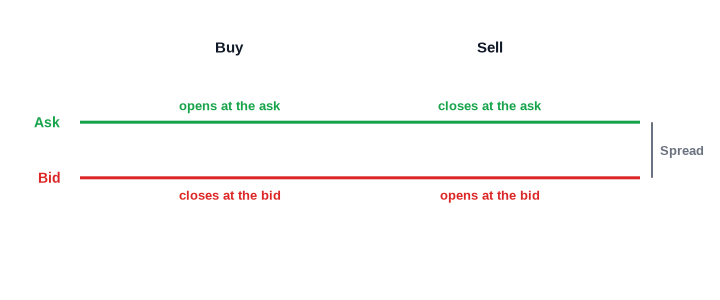
The ask is always a little higher than the bid. The difference between the two is the spread.
Where a buy opens and closes
When you buy, you buy from a seller, so you pay the ask. To close the buy, you have to sell it back, so it closes at the bid.
Buy: opens at the ask, closes at the bid.
Where a sell opens and closes
When you sell, you sell to a buyer, so you receive the bid. To close the sell, you have to buy back, so it closes at the ask.
Sell: opens at the bid, closes at the ask.
Why every trade starts slightly negative
Imagine the bid is 1.1000 and the ask is 1.1002. If you buy, you pay 1.1002. If you closed immediately, you would sell at 1.1000. You have lost the spread, 2 points, before price has moved at all. The same is true for a sell. Price has to move at least the size of the spread in your favour just to break even.
This is why the spread is a real cost of trading, and why it matters more for short-term traders who trade often and aim for small moves.
Why the chart can fool you
Most charting platforms draw candles using the bid price only. That has two consequences:
- A sell closes at the ask. If your stop-loss on a sell is just above a high, the ask can reach it while the bid-based chart shows price stopping short. The stop triggers even though the chart never "touched" it.
- A buy opens at the ask. A buy limit order placed exactly at a low on the chart may not fill, because the ask never reached that price.
Leaving a small buffer of at least the spread around your levels avoids most of these surprises.
When spreads get wider
Spreads are not fixed. They tend to widen:
- around important news releases;
- when markets are quiet, such as late at night or at the daily rollover;
- on less popular markets with fewer buyers and sellers.
A wide spread makes short-term trades more expensive and stops more likely to trigger. Many traders avoid trading in those moments.
Key points
- Bid: the price you sell at. Ask: the price you buy at. The difference is the spread.
- Buy: opens at the ask, closes at the bid.
- Sell: opens at the bid, closes at the ask.
- Every trade starts down by the spread.
- Charts usually show the bid, so leave a small buffer around your levels.
Risk warning: This article is for education only and is not financial advice. Trading involves a high risk of loss. Only trade with money you can afford to lose.