Learn › Read a candlestick
Spinning Top vs. Doji: What Is the Difference?
November 16, 2026 · 3 min read · By the Œil Du Marché team
Spinning tops and dojis look alike at first glance. Both have wicks on each side, and both show a market that could not decide where to go. But they are not the same candle, and confusing them is one of the first mistakes new chart readers make. This short guide explains the exact difference and how to tell them apart in a second.
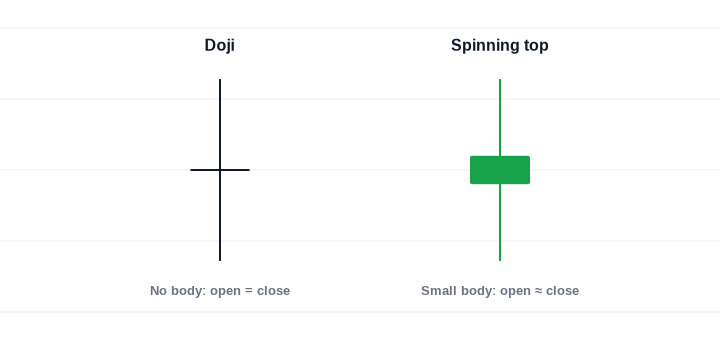
The doji: no body
A doji opens and closes at the same price. Since the body of a candle is drawn between the open and the close, the doji has no body at all. It is just a horizontal line with wicks.
The spinning top: a small body
A spinning top opens and closes at prices that are close to each other, but not equal. It has a small body in the middle and wicks of similar length above and below. The body can be green or red; the color matters less than its size.
Side-by-side comparison
| Doji | Spinning top | |
|---|---|---|
| Open and close | Same price | Close to each other |
| Body | None (a line) | Small |
| Wicks | Above and below | Above and below, usually longer than the body |
| Message | Complete indecision | Indecision, with a slight edge to one side |
What they have in common
Both candles show that buyers and sellers were close to balanced during the period. Price moved up and down, but neither side managed to finish far from the open. When either candle forms after a strong move, it suggests the move is losing momentum. When it forms at a key level, it can show the level is being tested.
Why the difference matters
A doji is a stronger sign of indecision than a spinning top, because the result of the period was exactly zero. A spinning top still shows a small winner. In practice, both are read the same way: as a pause, not as a signal. But naming candles correctly matters when you study, take notes, or answer questions in a course. Precise names lead to precise observations.
A quick test
When you are not sure which one you are looking at, zoom in. If you can see a rectangle, however small, it is a spinning top. If the body is only a line, it is a doji. On some charts, a very small body can be hard to see on a zoomed-out view, so always check before you name it.
How to use them
- Never trade either candle on its own.
- Pay attention when they appear after a long move or at support and resistance.
- Wait for the next candles to show which side takes control.
- Combine them with market structure: a pause at the end of a trend means more than a pause in the middle of one.
Key points
- Doji: open equals close, no body.
- Spinning top: open close to close, small body.
- Both have wicks on each side and show indecision.
- Both are warnings that need confirmation from the next candles.
Risk warning: This article is for education only and is not financial advice. Trading involves a high risk of loss. Only trade with money you can afford to lose.