Learn › Levels and zones
Order Blocks: What Makes One Valid
November 16, 2026 · 4 min read · By the Œil Du Marché team
Order blocks are one of the most popular ideas in modern price action trading, and one of the most over-drawn. Many beginners mark a box on every candle and call it an order block. This guide gives a strict definition, explains why the fair value gap matters, and shows how to tell a valid order block from a random candle.
What is an order block?
An order block (OB) is the last opposite candle before a strong move.
- A bullish order block is the last bearish (red) candle before a strong move up.
- A bearish order block is the last bullish (green) candle before a strong move down. This bearish version is often called a supply zone.
The idea behind it: large participants cannot fill big orders all at once. The area where the strong move started is where much of that buying or selling happened. When price returns to that area, there may be orders left, and price can react again.
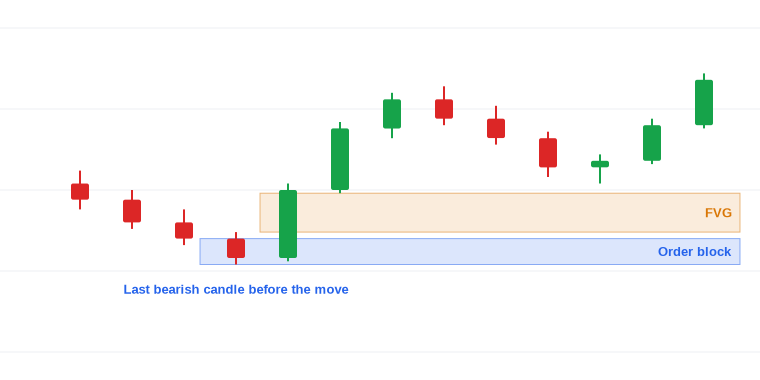
The two conditions for a valid order block
Not every last red candle before a green one is an order block. In the method taught in our community, a valid order block needs both of these:
- It is the last opposite candle before the move. For a bullish OB, it is the last bearish candle before price moves up strongly. Not the second-to-last, not a candle in the middle of the move.
- The move leaves a fair value gap (FVG). The move away from the order block must be strong enough to leave a fair value gap, an area where price moved so fast that the candles do not overlap. The FVG is the proof that the move was driven by real, aggressive orders and not just normal fluctuation.
If there is no FVG, the move was not strong enough, and the candle is just a candle.
How to draw an order block
- Find a strong move that leaves an FVG.
- Look at the candle just before the move started. If it is the opposite color, that is the OB candle.
- Draw a box from that candle's high to its low (some traders use only the body), and extend it to the right.
- Wait for price to return to the box. The first return is usually the most important one.
What makes an order block stronger
- It caused a break of structure. An OB whose move made a BOS or a CHOCH has shown it can change the market.
- It agrees with the trend. A bullish OB in an uptrend has the trend on its side.
- It has not been touched yet. Each return to an OB uses up some of the orders there. A fresh OB is usually stronger than one that has been tested several times.
Order blocks in different markets
The definition above comes from markets like forex, where a strong institutional move leaves clear footprints. Some short-term markets behave differently, with fewer clean impulses and more back-and-forth. In our community, we teach an extra filter for those markets: an order block is only considered valid when a support or resistance level has held at least three times and then breaks on the fourth test. The candle that starts that breakout forms the order block. Without that pressure building at a level, price usually just keeps ranging. Whatever market you study, the principle is the same: an order block must come from a move that clearly shows intent.
Common mistakes
- Marking every candle as an OB. No FVG, no OB.
- Picking the wrong candle. It must be the last opposite candle before the move.
- Ignoring structure. A bullish OB in a strong downtrend is more likely to break than to hold.
- Expecting every OB to work. An OB is an area where a reaction is more likely, not a guaranteed turning point.
Key points
- An order block is the last opposite candle before a strong move.
- A valid OB must be followed by a move that leaves a fair value gap.
- OBs that caused a BOS or CHOCH and agree with the trend are stronger.
- Fresh, untested OBs usually react better than ones touched many times.
Risk warning: This article is for education only and is not financial advice. Trading involves a high risk of loss. Only trade with money you can afford to lose.