Learn › Levels and zones
Fair Value Gap (FVG): How to Find and Use It
November 16, 2026 · 3 min read · By the Œil Du Marché team
A fair value gap, or FVG, is a small but powerful pattern made of three candles. It shows a moment when price moved so fast in one direction that it left an area behind where almost no trading happened. Fair value gaps are used to confirm strong moves, to validate order blocks, and as areas where price may return. This guide explains how to find and draw them.
What is a fair value gap?
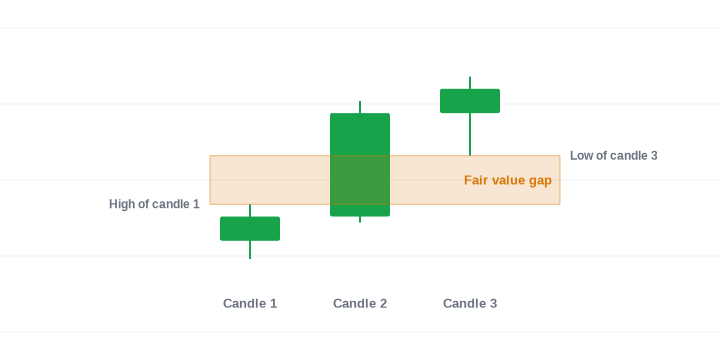
A fair value gap is a three-candle pattern where the wicks of the first and third candles do not overlap. The space between them is the gap.
- Bullish FVG: the low of candle 3 is above the high of candle 1. Candle 2 is a large bullish candle that moved price up so quickly that the area in between was barely traded.
- Bearish FVG: the high of candle 3 is below the low of candle 1, with a large bearish candle in the middle.
Why it is called "fair value"
Normally, price moves back and forth and trades through every level many times. Buyers and sellers agree on prices, and the market finds what traders call fair value. In a fair value gap, price jumped through an area too fast for that to happen. It is an imbalance: one side was so aggressive that the other side had no time to respond.
Markets often come back to fill, or partly fill, these imbalances later. That is why FVGs are watched as areas where price may return.
How to draw an FVG
- Find a large candle that moved quickly in one direction.
- Look at the candle before it (candle 1) and the candle after it (candle 3).
- For a bullish FVG, check that the low of candle 3 is above the high of candle 1. For a bearish FVG, check that the high of candle 3 is below the low of candle 1.
- Draw a box between those two prices and extend it to the right.
Three ways traders use FVGs
1. To confirm a strong move
An FVG proves that a move was aggressive. A break of structure that leaves an FVG is more convincing than one made with slow, overlapping candles.
2. To validate order blocks and supply zones
In the method we teach, an order block or supply zone is only valid if the move away from it leaves an FVG. No gap means the move was not strong enough, and the zone is not worth marking.
3. As a return area
When price comes back after a strong move, it often reaches into the FVG before continuing. In an uptrend, a bullish FVG below the current price can act like a cushion for a pullback.
Common mistakes
- Using candle bodies instead of wicks. The gap is measured between the wicks of candles 1 and 3.
- Marking tiny gaps on low timeframes. On a 1-minute chart, small gaps appear all the time and mean little.
- Ignoring context. An FVG against the trend is more likely to be filled and broken than to hold.
Practice exercise
On a 15-minute chart, find ten bullish and ten bearish FVGs. For each, note whether price came back into the gap later and whether it held or went through. You will start to see which gaps matter: usually the ones that formed during a break of structure.
Key points
- An FVG is a three-candle pattern where the wicks of candles 1 and 3 do not overlap.
- It shows an imbalance: price moved too fast for normal two-way trading.
- It confirms strong moves and validates order blocks and supply zones.
- Price often returns into FVGs, but not every gap holds.
Risk warning: This article is for education only and is not financial advice. Trading involves a high risk of loss. Only trade with money you can afford to lose.