Learn › Market structure
The Quasimodo (QM) Setup Explained Step by Step
November 16, 2026 · 4 min read · By the Œil Du Marché team
The quasimodo, usually shortened to QM, is a price action setup built entirely from market structure. It combines two ideas you may already know, the break of structure (BOS) and the change of character (CHOCH), into one clear level on the chart. This guide explains how a QM forms, how to mark the QM level, and how to practise finding it.
The building blocks
Before you can find a QM, you need to be comfortable with:
- Market structure: highs, lows, HH, HL, LH and LL.
- Break of structure (BOS): a break with the trend.
- Change of character (CHOCH): the first break against the trend.
What is a QM?
A QM setup uses the last BOS before a CHOCH. The rule is simple:
Once the CHOCH has formed, the level of the last BOS becomes the QM level.
Until the CHOCH happens, there is no QM. The BOS levels are just part of the trend. The CHOCH is what turns the last one into a level worth watching.
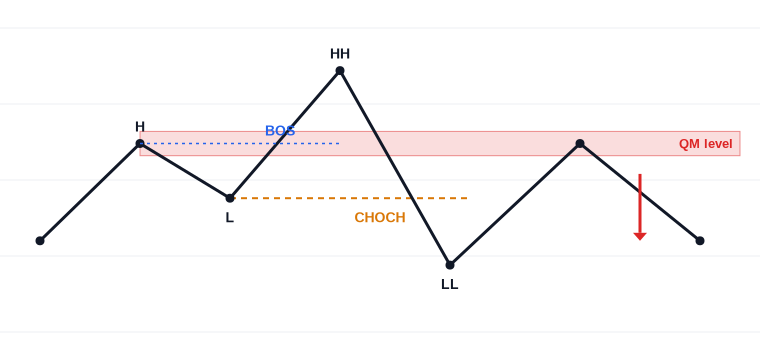
A sell QM step by step
- The trend is up. Price makes a high (H), then a pullback low (L).
- BOS. Price breaks above H and makes a higher high (HH). This is the last BOS of the uptrend. The level of H is the level that was broken.
- CHOCH. Instead of making a higher low, price falls and breaks below L, making a lower low (LL). The uptrend's structure is broken.
- The QM level. Now that the CHOCH has formed, the level of the last BOS, the old high H, becomes the QM level.
- The return. Traders who use this setup watch for price to come back up to the QM level, where they expect sellers to step in.
A buy QM
The buy version is the mirror image. In a downtrend, price makes a low, a bounce high, then breaks below the low (the last BOS). Then price rallies and breaks above the bounce high (the CHOCH). The low that was broken by the last BOS becomes the QM level, and traders watch for price to come back down to it.
Why the QM level can work
The QM level is where the old trend made its last successful break. When the CHOCH shows that the trend has lost control, the market often returns to that area before moving in the new direction. Traders who were caught on the wrong side of the CHOCH may use the return to exit, and traders following the new direction may use it to enter. That combination can make the level react.
"Can" is the important word. No level works every time. A QM is a place to watch, not a promise.
Making the setup stronger
- Higher-timeframe agreement. A sell QM inside a higher-timeframe supply zone has more behind it than one in the middle of a strong uptrend.
- A clean CHOCH. A CHOCH made with strong candles, ideally leaving a fair value gap, shows real intent.
- Confirmation at the level. Many traders wait for a reaction at the QM level on a lower timeframe, such as a small CHOCH, before considering an entry.
Common mistakes
- Marking the QM before the CHOCH. Without the CHOCH, it is not a QM. It is just an old high.
- Using the wrong BOS. The QM comes from the last BOS before the CHOCH, not an older one.
- Trading it before you can mark it reliably. Spend time practising first.
How to practise without risk
The best way to learn the QM is to mark it, not to trade it. Open charts, find a trend, mark the BOS levels, wait for a CHOCH, and draw the QM level. Then watch what price does when it returns. Do this for weeks on many charts before you consider risking any money. The method is described in how to practise reading charts without risking money.
Key points
- A QM uses the last BOS before a CHOCH.
- Once the CHOCH forms, the level of the last BOS becomes the QM level.
- Sell QM: the old high. Buy QM: the old low.
- It is a level to watch for a reaction, not a guaranteed turning point.
Risk warning: This article is for education only and is not financial advice. Trading involves a high risk of loss. Only trade with money you can afford to lose.